
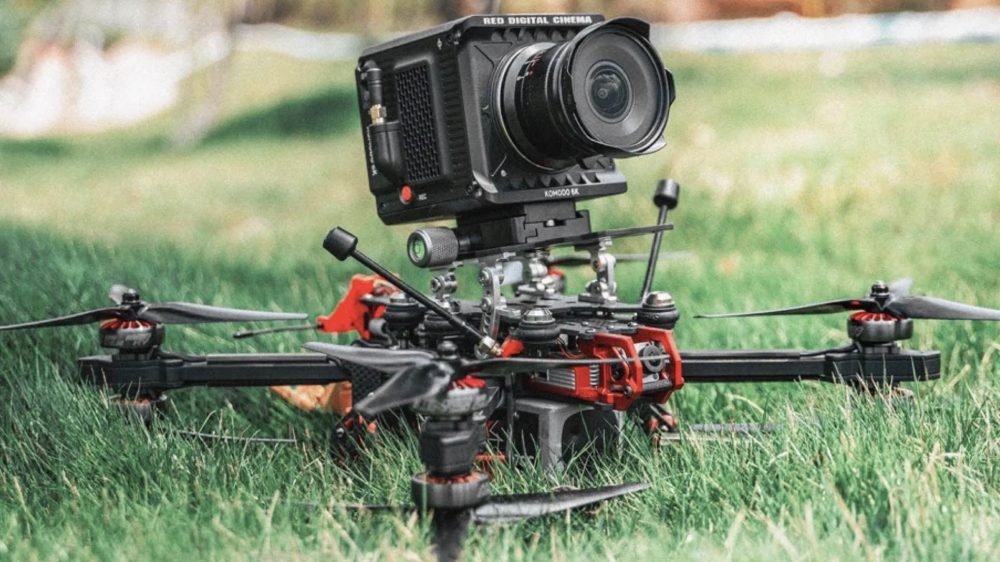
When you hear the words ‘action cam’, we tend to immediately think of GoPro, but in the world of filmmaking, the term can mean something very different. There is a definite demand for smaller cameras on set that can be used to capture more exciting, dynamic shots, be it from a drone or from a body mounted camera. And when it comes to high end productions, this ‘stunt’ camera must produce an image that is on par with, or at least very close to, the primary camera system.
In the past, films such as Michael Bay’s Transformers used GoPros for close action shots, next to explosions, or car crashes. However, their use was controlled, and any shots from them that appeared in the final movie were really short. Jarred Land, Director of RED Digital Cinema, explained in a live stream session held by Scott Balkum that the GoPro “didn’t cut well” in high-end productions and also was limited to 20 frames before the audience could notice the difference between the GoPro and other cinema cameras. Furthermore, the rolling shutter artifacts were significantly noticeable especially in action shoots (fight scenes, crash-cam, etc).
Simply put, the GoPro, although very robust, lacks the image quality needed for cinema. So, when it comes to using cameras for stunt and action sequences, big budget, mainstream filmmakers are now turning to many of the tools used by independent filmmakers, including lenses. Cameras that were once reserved for music videos and small scale productions are now finding their way onto big budget sets in multi-million dollar blockbusters. As technology improves, these systems are now deemed close enough in quality to the A-cameras that they can be used without restriction on productions that demand the absolute best image quality possible, allowing directors to take their action sequences to a whole new level.
Let’s take a closer look:
RED KOMODO
Despite its popularity as a main production camera, RED’s KOMODO was in fact designed for stunt camera use. Its compact body along with a Canon RF-Mount system, makes it versatile and lightweight, and perfect for capturing the action up close and personal. For instance, The Batman used two body mounted KOMODOs during the wing suit sequence — one mounted on the helmet looking down the back of the wingsuit, and the other mounted off an arm looking at the actor’s face.
Proper action cinema cameras must be capable of both a global shutter and high Dynamic Range. One of the main appeals of KOMODO for action sequences is its global shutter that can deliver a decent DR that is good enough for professional productions. This means that it can be used in fast action shots where there is risk of high vibration, or to shoot difficult ‘flash’ light, such as explosions, without any of the rolling shutter issues found on other devices.

This was one of the main reasons why KOMODO was used extensively throughout Matrix: Resurrections for the movie’s many high octane action sequences. A KOMODO was even melted while taking a shot during a vehicle explosion. The footage actually survived to make it into the final edit.
“We loved the KOMODO,” says Daniele Massaccesi. “It’s such a small body you can place it anywhere. We used it a lot in vehicles. On a movie like this with lots of fast motion, gunfire and explosions, you want the action to be as hard and as high resolution as possible. The global shutter eliminates that rubber motion you get from cameras with conventional shutter. It’s a terrific camera.”
– Daniele Massaccesi, Matrix: Resurrections Co-Cinematographer
Because KOMODO can shoot 6K, it has the same post flexibility of the larger REDs, allowing for stabilisation, reframing, as well as 120fps potential at 2K resolutions.
Recently the use of KOMODO has literally been taken to new heights in Michael Bay’s Ambulance, when it was used as an FPV drone camera. This kind of sequencing has revolutionised the way action movies are shot as the action sequences are extremely fast. Drones help capture shots that would not otherwise have been possible. Ambulance demonstrates the types of shot that you could only previously achieve with a GoPro, such as flying underneath a car during a chase scene as it launches into the air from a ramp. It is the first film screened in the theater (post-COVID era) that extensively utilises this technique using a cinema camera.
Using this ‘Cinema FPV’ technique really makes you move with the intensity of the action with rich, high definition shots. The compact form, global shutter and advanced tech in KOMODO allowed Bay to get right into the heart of the action. In many situations, he would take the camera without stabilisers, without a gimbal, and just run with it in his hands. Even lead actor Jake Gyllenhaal shot some action scenes himself. The film is non-stop intensity, and KOMODO was able to keep up with Bay’s special brand of high intensity action.

The Cinema FPV technique was also previously used on the set of Netflix’s action film Red Notice, directed by Rawson Marshall Thurber. In the opening shot, Thurber flies the audience over a bridge and straight into an eye-level shot of the Agent John Hartley character. From flight to the door to a museum, the camera never appears to cut, offering an added level of immersion for the audience. Thurber explains in an interview on comicbook.com. “Yeah, those are very, very special shots. In fact, those shots that you’re talking about had never been done before in the history of cinema, because the technology that we use to achieve those shots, you know, were invented about six weeks before we used them.” He continues: “There’s a tiny camera called the Komodo Camera from RED that’s about the size of a tissue box and we attached it to a race drone. There are shots in the movie we could only get with something that small that comes with high-res imagery. This is a 6K cinema grade quality camera and so we attached it to a race drone, put a small spherical lens on it, and we hired this incredible race drone operator named Johnny FPV, who’s the best in the world, to achieve these shots.”
Blackmagic Design Pocket Cinema Camera
The BMPCC has been used on features and TV as stunt cameras for a while now, for example, on episodes of 24 as well as movies such as Logan, Jason Bourne, and Avengers: Age of Ultron
More recently it has been used for action sequences during The King’s Man. Second unit director, Bradley Allan, described how the BMPCC 6K cameras were either mounted on Ronin 2 rigs or handheld for some of the key action sequences.
The BMPCC are lauded for their ability to grade easily to match other systems such as ALEXA (ARRI Alexa 65 In the case of The King’s Man). They are also extremely lightweight, and for a feature film at least, inexpensive enough to be ‘disposable’ when it comes to dangerous action. They have, additionally, been praised for their reliability.
A side note: The same film also used the Sony A7S III for head mounted POV style shots during fight sequences.
Sony VENICE
Top Gun: Maverick was one of the first features to be shot using Sony’s VENICE camera system.
Maverick not only used VENICE as the primary A-camera, but also as an action camera, mounted inside the fighter jet cockpits. In fact, the production was able to supposedly mount six VENICE 6K Cinema cameras there, which included the Rialto Camera Extension System for Sony VENICE. This effectively separates the sensor and lens system from the primary camera body.

Each camera used a different lens to ensure a variety of shots, and the actors operated them whilst the planes were in flight. This meant that the cast had to get a decent cinematography education so they could work these sophisticated cinema cameras inside the cockpit. Almost no CGI aerial shots were therefore needed in the film, and the close-up cockpit shots were taken during real in-flight sequences, giving the film super immersive and jaw-dropping flight sequences.
Not only is there the flexibility of the Rialto extension system, but the Sony VENICE camera is also IMAX certified, which for a film like Top Gun: Maverick, was important as it was filmed for IMAX.
